
Tool RAG
Dynamic tool selection using semantic search. Instead of loading all tools into context, retrieve only the relevant ones for each query.
The Problem
Context Bloat
Each tool definition consumes tokens:
Tool: get_weather
Description: Get current weather for a location...
Parameters:
  - location (string): The city name...
  - units (enum): celsius/fahrenheit...

≈ 50-100 tokens per tool
With 50 tools = 2,500-5,000 tokens just for tool definitions.
Performance Degradation
Research shows tool accuracy decreases as tool count increases:
| Tool Count | Success Rate |
|---|---|
| 5 tools | 95% |
| 20 tools | 85% |
| 50 tools | 70% |
| 100+ tools | <60% |
The Solution
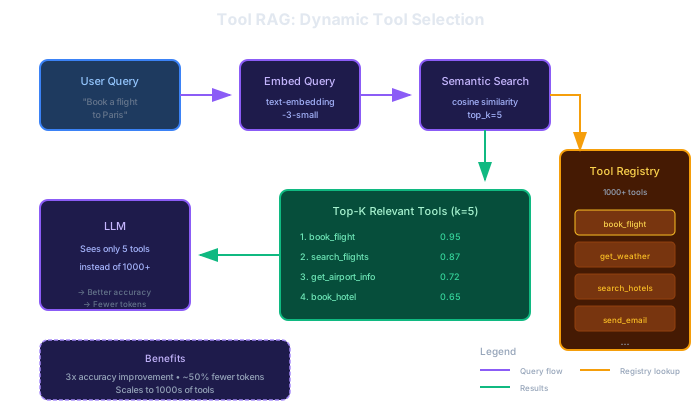
Benefits
Research from Red Hat and AWS shows accuracy improvements, and our own benchmarks demonstrate:
- 60% context reduction when combined with TOON format (accounting for RAG round-trip overhead)
- 65% reduction in tool definition context alone
- Scales to thousands of tools without degradation
How It Works
1. Tool Registration
When tools are registered, their descriptions are embedded:
python
async def register_tool(self, tool: ToolDefinition):
    # Generate embedding from description
    embedding = await self.embed(
        f"{tool.name}: {tool.description}"
    )

    # Store in vector index
    await self.index.upsert(
        id=tool.name,
        vector=embedding,
        metadata=tool.to_dict()
    )
2. Query Processing
When a query comes in, embed it and search for matches above the similarity threshold:
python
async def search(self, query: str, threshold: float = 0.5):
    # Embed the query
    query_embedding = await self.embed(query)

    # Search vector index for all matches above threshold
    results = await self.index.search(
        query_embedding,
        threshold=threshold
    )

    # Return tool definitions
    return [r.metadata for r in results]
3. Integration with Armory
Tool RAG integrates at the gateway level:
python
class Armory:
    async def handle_tools_list(self, request):
        if self.tool_rag_enabled and request.context:
            # Return only relevant tools (above threshold)
            tools = await self.tool_rag.search(
                request.context,
                threshold=0.5
            )
        else:
            # Return all tools
            tools = await self.registry.list_all()

        return tools
Embedding Strategies
| Strategy | What to Embed | Pros/Cons |
|---|---|---|
| Description only | Tool description text | Simple, may miss nuance |
| Description + params | Description + parameter names | More context, better matching |
| Synthetic queries | Generated example queries | Best accuracy, more compute |
Embedding Models
| Model | Dimensions | Speed | Cost |
|---|---|---|---|
| text-embedding-3-small | 1536 | Fast | $0.02/1M tokens |
| text-embedding-3-large | 3072 | Medium | $0.13/1M tokens |
| all-MiniLM-L6-v2 (local) | 384 | Very Fast | Free |
| BGE-large (local) | 1024 | Medium | Free |
Configuration
yaml
# In armory.yaml
tool_rag:
  enabled: true
  embedding_model: "text-embedding-3-small"
  similarity_threshold: 0.5  # Return all matches above this threshold
  cache_embeddings: true     # Cache query embeddings
Metrics
python
class ToolRAGMetrics:
    def recall(self, query, expected_tools, threshold=0.5):
        """What % of needed tools were retrieved?"""
        retrieved = self.search(query, threshold=threshold)
        return len(set(retrieved) & set(expected_tools)) / len(expected_tools)

    def precision(self, query, expected_tools, threshold=0.5):
        """What % of retrieved tools were actually needed?"""
        retrieved = self.search(query, threshold=threshold)
        if not retrieved:
            return 0.0
        return len(set(retrieved) & set(expected_tools)) / len(retrieved)

    def f1(self, query, expected_tools, threshold=0.5):
        """Harmonic mean of precision and recall"""
        p = self.precision(query, expected_tools, threshold)
        r = self.recall(query, expected_tools, threshold)
        if p + r == 0:
            return 0.0
        return 2 * (p * r) / (p + r)
References
- Our Benchmark: Cutting Context by 60% — Detailed methodology and results
- Tool RAG: Dynamic Tool Discovery — Implementation in Agentic Forge
- Tool RAG: The Next Breakthrough (Red Hat)
- Dynamic ReAct Paper
- AWS Strands SDK - Dynamic Tool Loading