
Architecture Overview
Agentic Forge is built from modular components that work together to create efficient, interoperable AI agents with smart tool management.
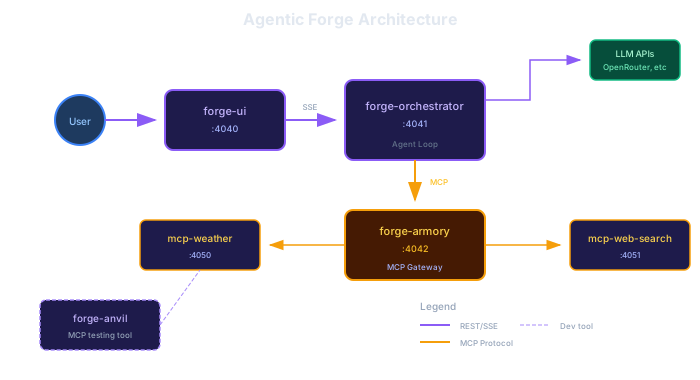
Components
| Component | Description |
|---|---|
| Orchestrator | Standalone component managing the LLM conversation loop with model routing, tool routing, and hooks for observability. |
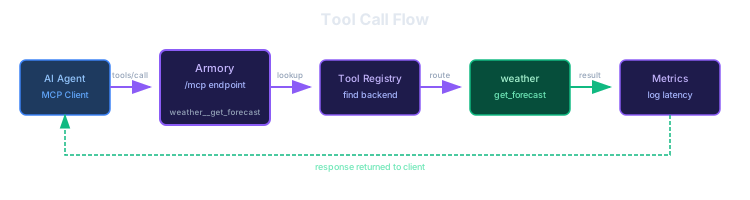
| Armory | Protocol gateway that aggregates multiple tool sources and exposes them through a unified MCP interface. |
| Tool RAG | Dynamic tool selection using semantic search to reduce context usage and improve accuracy. |
| Interfaces | CLI, Web UI, WebSocket API, and Python SDK for interacting with the system. |
| Anvil | CLI and web-based inspector for testing and debugging MCP servers during development. |
Key Innovations
Protocol Interoperability
Different LLMs output tool calls in different formats (OpenAI, Anthropic, Gemini, etc.). Agentic Forge normalizes these through Pydantic AI and translates to whatever backend format is needed.
Token Optimization with TOON
Tool results are converted from JSON to TOON (Token-Oriented Object Notation) at the gateway level, achieving 15-40% token savings (scaling with data size) without requiring changes to existing MCP servers or tools.
Smart Tool Selection
Instead of loading all tools into context, Tool RAG uses semantic search to dynamically select only relevant tools. Our benchmarks show 60% context reduction when combined with TOON format.
Interactive Tool UIs with MCP Apps
Tools can include interactive UI components that render in the chat. Our location picker demonstrates this—users click on a map to select coordinates instead of typing them. Built on the MCP Apps specification with sandboxed iframes and JSON-RPC messaging.
Data Flow
Technology Stack
| Layer | Technology | Purpose |
|---|---|---|
| Framework | Pydantic AI | Model abstraction, type-safe tools |
| Protocol | MCP (Streamable HTTP) | Tool communication standard |
| Format | TOON | Token-efficient data encoding |
| Search | Vector embeddings | Semantic tool matching |
| API | WebSocket + REST | Real-time streaming + management |